A new-designed
system for continuous measurement of radon in water.
https://www.sciencedirect.com/science/article/abs/pii/S0969804322002111
|
On-line
continuous monitoring of radon concentration in water is of great
significance for its environmental application as a radioactive
tracer, for example, as a potential precursor for earthquake
forecast and volcanic
eruption.
To realize on-line continuous measurement on radon in complex water
body, a compact measurement system mainly consisted of a simple
degassing device and an electrostatic radon monitor is
newly developed. The sensitivity of the measurement system is
73 ± 5 cph/(Bq/L), and the detection limit is
0.04
Bq/L with a 60-min cycle at 25 °C water temperature.
Intercomparison measurements with RAD H2O were performed both in
laboratory condition and in field, and consistent results within the
error range were achieved. To test the developed measurement system, a
continuous monitoring of radon concentration in water in the drainage
tunnel of Mount Jinping was performed for 3 months. The arithmetic mean
of radon concentration in water is 0.34 ± 0.09
Bq/L,
varying in the range of 0.04–0.60 Bq/L during the period.
Several rapid
decreases of radon concentration in water were observed, which might be
attributed to the increase of rainwater mixing
in the drainage tunnel caused by heavy rainfall. The stability of
long-term operation of the system enables it to be widely used in the
field of radon in water as a tracer. |
|
|
http://www.w1m3a.cnr.it/OI1/modules/site_pages/fixo3_TNA.php
|
A
long-term experiment was setup to install two complementary new
instruments on the W1M3A observatory in the Ligurian Sea. The
scientific aim of the experiment was to understand and characterize the
distribution and pattern of oceanic wind fields and rainfall which
constitute some of the major components of global/regional water cycle
and climate change. One instrument is an autonomous underwater in-situ
radioactivity sensor based on gamma-ray spectrometry which measures
artificial (like iodine and caesium) and natural (like radon and
thoron) radioactivity. The continuous monitoring of gamma radiation in
the marine environment provides significant information on various
environmental processes where radon and thoron can be applied as a
tracers. Radon can be detected via its daughters (214Bi
and 214Pb)
which are gamma-ray emitters. 222Rn
is a noble gas and is found in aerosol particles in accumulation-mode.
It has been observed qualitatively after rainfall from the short-lived
radon daughters (214Bi
and 214Pb).
However, the variation of radon activity is not constant mainly due to
rainfall intensity, rainfall type and humidity. It has been measured
that volumetric activity of radon decay products in rainwater amounts
up to 105 Bq/l.
The other instrument is a smart acoustic recorder which can be used to
detect and classify rainfall type and quantify the wind speed, rainfall
rate and drop size distribution. The principle on which the sensor is
based on is that rain drops falling into the ocean surface produce
sound underwater by their impacts and, more importantly, by sound
radiation from any bubbles trapped underwater during their splashes. In
addition, because different raindrop sizes produce distinctive sounds,
the underwater sound can be inverted to quantitatively measure drop
size distribution in the rain., the break of the surface waves
(strongly correlated to wind blowing over the sea) are two of the
loudest sources of underwater sound. Additionally sounds generated from
biological and human activities can be detected. |
|
|
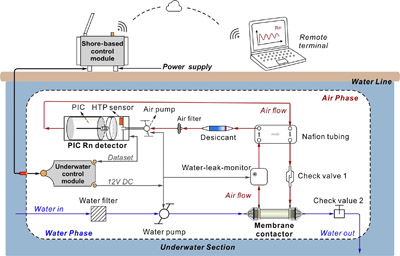
In-situ radon-in-water
detection for high resolution submarine groundwater discharge assessment
https://www.frontiersin.org/journals/marine-science/articles/10.3389/fmars.2022.1001554/full
in-ru
|
Submarine
groundwater discharge (SGD), including both land-based fresh
groundwater that enters the ocean from coastal aquifers as well as
recirculated seawater that is continuously recharged and discharged on
the seabed, has been considered as an important component of the global
water and biogenic element (e.g., nitrogen, phosphorus, silicon and
carbon) sources and a significant pathway for material exchange at the
land-sea interface of coastal ecosystems. Some researchers reported
that SGD associated nutrient additions to coastal waters have caused
unwanted ecological issues, including red tides, coastal acidification
and hypoxia. Natural radon isotope (222Rn,
t1/2 =
3.8 d)
is an excellent tracer for studying SGD and other oceanographic
processes including air-sea gas exchange, sediment-water diffusion, and
earthquake prediction. However, the conventional radon measurement
methods suffer many technical disadvantages. We consequently developed
a convenient submersible radon determination approach
(“OUC-Rnâ€) using
a commercial pulsed ionization chamber (PIC) radon sensor and gas
extraction membrane module to produce high precision and high
resolution observations. We demonstrate the radon degassing efficiency
of the membrane contactor is comparable to the shower-head type
air-water exchanger but is independent of operating position. The radon
measurement efficiency of the PIC is 2-fold higher than the RAD7
detector and is far less influenced by moisture. We successfully
deployed the system in 2.5 meters water depth over a 100 hours period
in an anthropogenic influenced bay. Based on our high temporal
resolution observations, the SGD flux was estimated to be
0-43.0 cm/d (mean: 25.4 ± 14.5 cm/d). The SGD fluxes
pattern plotted together with the tidal variations revealed that tidal
pumping may be the main force driving seawater recirculation into
aquifers and thus affecting nutrient, carbon and other dissolved
matters dynamics in coastal regions. |
|
|
Development
of an underwater radon detector.
https://inis.iaea.org/records/6mww2-5h108
|
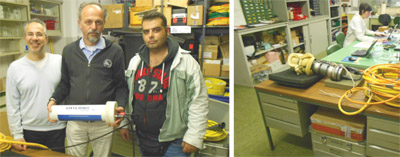
We
newly developed an underwater radon detector for 222Rn concentration
determinations in water. A PIN photodiode (PD), an alpha particle
detector, installed inside a container attracts radon families when
charged electrostatically. Alpha particles emitted from 218Po (RaA),
214Po (RaC'), 210Po (RaF) and 212Po (ThC') are completely isolated from
each other. This system can be applied to a half year period
observation for wide variation of radon concentrations from 0.5 Bq/m3
in pure water to 10000 Bq/m3 in underground water. The observed results
of pure water radon concentration in the KAMIOKANDE tank showed that
this technique is valid for the monitor of the degasification system.
(author) |
|
|
An
underwater sensing system for monitoring radioactivity
in the marine environment.
C. TSABARIS 1 and I. THANOS
|
Abstract
We describe a set up and an application for an
autonomously working, radioactivity sensing instrument,
usable in seawater and river environments. The system is based on a
¡aI
scintillator with the appropriate
specifications for use in the marine environment and for real time
acquisition. It is simple, stable for longterm monitoring, and of low
consumption. Many tests were carried out for the linearity and the
stability of
the electronics. The investigation of energy resolution and energy
calibration of the sensor was performed in
the laboratory using various reference point radioactive sources. The
system was also deployed in a water
tank in order to measure background radiation in the water and low
volumetric activity of 137Cs (17 Bq/m3).
Appropriate software identifies qualitatively the low level 137Cs
contribution to the measured Ã-ray spectrum. |
|
|
Development
and oceanographic applications of
underwater in-situ radon sensor using plastic scintillator.
https://warwick.ac.uk/fac/sci/eng/research/grouplist/sensorsanddevices/mbl
/database/ieeesensors09/PDFs/Papers/395_5288.pdf
|
Abstract
Underwater in-situ radon measurement is
important
scientific priority for oceanography, especially for survey and
monitoring of submarine groundwater discharge (SDG). The
high sensitivity and lightweight underwater in-situ radon
sensor using NaI(Tl) doped plastic scintillator was developed
for oceanographic applications. A NaI(Tl) doped plastic
scintillator can expect high sensitivity in comparison with a
NaI(Tl) crystal sealed in a container because the plastic
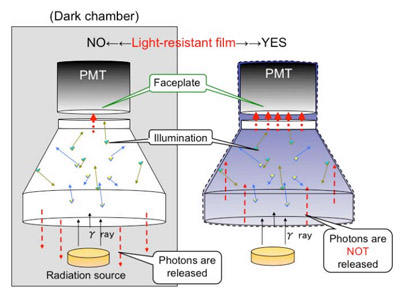
scintillator contacts seawater directly. The newly developed
underwater in-situ radon sensor can apply to various fields
because the plastic scintillator is coated by light-resistant paint
instead of using a dark chamber. Sensitivity sea tests and
mapping survey were carried out at shallow hydrothermal
area. The sensor was able to respond quickly to hydrothermal
radon at seafloor and detect hydrothermal radon to 20m above
the hydrothermal point (seafloor). The sensor was carried
along mapping grid (40m X 40m area, 5m intervals) at 1m
layer above the seafloor by diver. The signals of the radon
sensor ranged from 20 to 66 mV, and these signals
corresponded with radon concentration of 2 to 12 becquerels
per liter. Since the sensor is small and lightweight,
measurement, monitoring and mapping can perform
automatically by installing the sensor to an AUV (autonomous
underwater vehicle). Furthermore, underwater in-situ radon
sensor is expected an application to earthquake prediction and
volcanic activity monitoring as well as oceanography and
hydrology |
|
|
Continuous
measurement of radon in water
|
ABSTRACT:
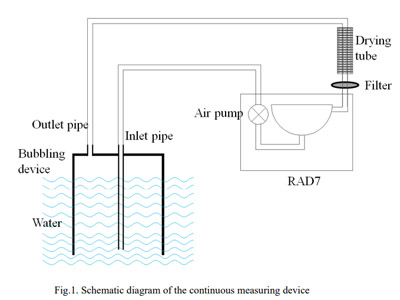
Radon is a radioactive gas and can move freely through air and water. A
novel
bubbling device was developed for continuous detection of radon
concentrations in water. After a
period of circulating and bubbling, the radon concentration in the
water reached equilibrium with
the radon concentration in the gas path, and the continuous change in
radon concentration in water
can then be obtained by continuously monitoring the radon concentration
in the gas path.
KEYWORDS: Radon in water; Continuous measurement; Bubbling method;
Equilibrium time |
|
|
|
|
|
|
|
|
|
|
|
|
Further
refinements of a continuous radon monitor for surface ocean water
measurements.
Chunqian Li1,2† Shibin Zhao3,4,5† Chenglun Zhang2
Meng Li1Jinjia Guo1 Natasha T. Dimova6 Tong Yang1 Wen Liu3,4,5
Guangquan Chen7 Huaming Yu8 Bochao Xu3,4*
|
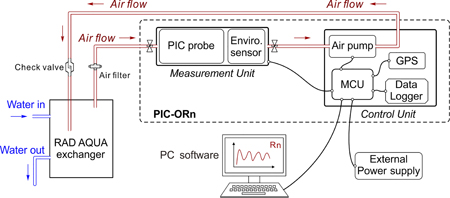
Radon
is an excellent natural tracer for studying various geophysical
processes. In the past centuries, radon isotopes measurement approaches
for marine research have been fully developed but still suffer
limitations. Here we present the setup and validation of an improved
continuous online measurement system (PIC-ORn) to measure dissolved
radon in the surface ocean and other water bodies. We demonstrated that
the PIC measurement efficiency is ~2 times higher than a RAD7 and is
less affected by relative humidity and produces reliable results.
Laboratorial measurements indicated that the new PIC-ORn system
responded timely to the change of radon activities in water. The new
system was successfully deployed during a cruise to the northwest
Pacific Ocean in June 2021. Despite low radon-in-water activities, the
results obtained by the new PIC-ORn system matched the traditional
measurement systems within the estimated uncertainties. The PIC-ORn
detector takes advantage of higher efficiency, lower cost, and power
consumption, and is less affected by air moisture. The new system does
not rely on drying units, further reducing on-site supervision, which
would benefit the researches in submarine groundwater advection and
diffusion and ocean-atmosphere gas exchange. |
|
|
|
|
|
|
|
|
|
|
|
|
|
|
|
|
|
|
|
|
|
|
|
|
|
|
|
|
|
|
|
|
|
|
|
|
|
|
|
|
|
|
|
|
|
|
|
|
|
|
|
|
|
|
|
|
|
|
|
|
|