WWW.VOLCANICLAKES.COM
|
Library
|
|
Floating storage chambers.
Measuring radon from a water surface
using floating chambers
involves trapping the radon gas as it emanates from the water into a
sealed, floating chamber, then using a sensor to measure the
concentration over time.
The chamber is placed on the water's surface, and the radon exhalates
from the water into the chamber's enclosed air. A detector, such as a radon-in-air
monitor,
measures the radon or its decay products in the chamber's air to
determine the exhalation rate.
|
|
It
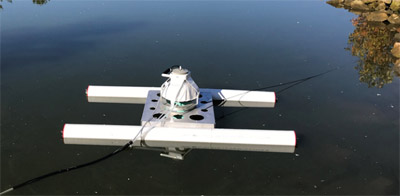
is possible to make gas flux measurements from the water surface by
placing a LI-COR soil
flux chamber onto a floating platform. While this is possible with both
the Smart Chamber for survey measurements and long-term chambers, we
will here focus on the more practical survey approach using the Smart
Chamber. The Smart Chamber is more practical than long-term chambers on
account of the symetrical shape, which has a stable center of mass. Figure
1 shows
a floating chamber platform featuring several recommended features. |
|
|
|
|
|
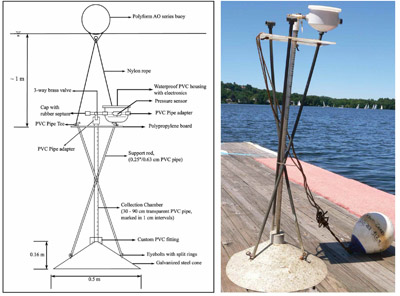
1. A
low-cost automated trap to measure bubbling gas fluxes.
|
|
|
|
2.
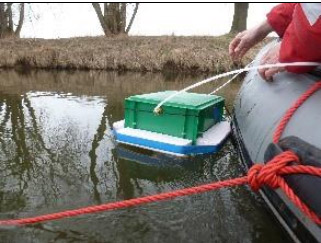
Technical note: drifting versus anchored flux chambers for
measuring greenhouse gas emissions from running waters
|
Abstract.
Stream networks have recently been discovered
to be major but poorly constrained natural greenhouse gas
(GHG) sources. A fundamental problem is that several
measurement approaches have been used without crosscomparisons. Flux
chambers represent a potentially powerful
methodological approach if robust and reliable ways to use
chambers on running water can be defined. Here we compare the use of
anchored and freely drifting chambers on various streams with different
flow velocities. The study clearly
shows that (1) anchored chambers enhance turbulence under
the chambers and thus elevate fluxes, (2) drifting chambers
have a very small impact on the water turbulence under the
chamber and thus generate more reliable fluxes, (3) the bias
of the anchored chambers greatly depends on chamber design and sampling
conditions, and (4) there is a promising
method to reduce the bias from anchored chambers by using
a flexible plastic foil collar to seal the chambers to the water
surface, rather than having rigid chamber walls penetrating
into the water. Altogether, these results provide novel guidance on how
to apply flux chambers in running water, which
will have important consequences for measurements to constrain the
global GHG balances. |
|
|
3.
|
Aquatic ecosystems
are major sources of greenhouse gases (GHGs). Robust measurements of
natural GHG emissions are vital for evaluating regional to global
carbon budgets and for assessing climate feedbacks of natural emissions
to improve climate models. Diffusive and ebullitive (bubble) transport
are two major pathways of gas release from surface waters. To
capture the high temporal variability of these fluxes in a well-defined
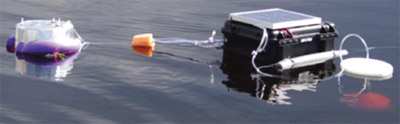
footprint, we designed and built an inexpensive device that
includes an easily mobile diffusive flux chamber and a bubble
counter all in one. In addition to automatically collecting gas samples
for subsequent various analyses in the laboratory, this device also
utilized a low-cost carbon dioxide (CO2)
sensor (SenseAir, Sweden) and methane (CH4)
sensor (Figaro, Japan) to measure GHG fluxes. Each of the devices was
equipped with an XBee module to enable local radio communication
(DigiMesh network) for time synchronization and data readout at a
server controller station on the lakeshore. The software of this server
controller was operated on a low-cost computer (Raspberry Pi), which
has a 3G connection for remote control and monitor functions from
anywhere in the world. This study shows the potential of a low-cost
automatic sensor network system for studying GHG fluxes on lakes in
remote locations.
|
4. A
simple and cost-efficient automated floating chamber for
continuous measurements of carbon dioxide gas flux on lakes.
Kenneth Thorø Martinsen1
, Theis Kragh1
and Kaj Sand-Jensen1
1
Freshwater Biological Laboratory, Biological Institute, University of
Copenhagen, Universitetsparken 4, 3rd. floor, 2100
5 Copenhagen, Denmark
|
Abstract.
Freshwaters emit significant amounts of CO2 on a global scale. Yet,
emissions remain poorly constrained from the
diverse range of aquatic systems. The drivers and regulators of CO2 gas
flux from standing waters require further
investigation to improve knowledge on both global scale estimates and
system scale carbon balances. Often lake-atmosphere
10 gas fluxes are estimated from empirical models of gas transfer
velocity and air-water concentration gradient. Direct
quantification of the gas flux circumvents the uncertainty associated
with the use of empirical models from contrasting
systems. Existing methods to measure CO2 gas flux are often expensive
(e.g. eddy-covariance) or require a high workload in
order to overcome the limitations of single point-measurements using
floating chambers. We added a small air pump, timer
and an exterior tube to ventilate the floating chamber headspace and
passively regulate excess air pressure. By automating
15 evacuation of the chamber headspace, continuous measurements of lake
CO2 gas flux can be obtained with minimal effort.
We present the chamber modifications and an example of operation from a
small forest lake. The modified floating chamber
performed well in the field and enabled continuous measurements of CO2
gas flux with 40-minute intervals. Combining the
direct measurements of gas flux with measurements of air and waterside
CO2 partial pressure also enabled calculation of gas
exchange velocity. Application of the described floating chamber is
straightforward and modifications are both simple and
20 cost-efficient to perform. Changing the chamber dimensions to
particular applications and systems makes this approach to
measure gas flux flexible and appropriate in a range of different
systems. |
|
|
|
|
Here
we present first results of an inexpensive, semi-automatic,
do-it-yourself (DIY) floating chamber design, which can be used for
in-situ measurements of CO2 and
CH4 emissions
from ponds and ditches. The floating chamber design consists of a
star-shaped floating body (“rose dich”) with a cantered PVC chamber (A:
0,194 m²; V: 0,63m³. Low-cost NDIR-Sensors were attached to
the chamber, for measuring CO2 (SCD30;
400-5,000 ppm, ± 50 ppm accuracy) and CH4 concentrations
(Figaro Gas-Sensor TGS-2611; …). Environmental conditions during
chamber deployment were recorded using a DHT-22 (humidity and
temperature) and a BMP280 (air pressure) sensor device. All sensors
were connected to a Bluetooth enabled, battery powered, compact
microcontroller-based logger unit for data visualization and storage.
Measured CO2 and
CH4 emissions
from ditches and ponds obtained on three locations spread over NE
Germany were validated against in parallel performed GHG flux
measurements using evacuated glass bottles for air sampling and
subsequent GC-14A and GC-14B analyses (Shimadzu Scientifec Instruments,
Japan).
|
|
|
Methodological
approach for the collection and simultaneous
estimation of greenhouse gases emission from aquaculture
ponds
|
Abstract
Global warming/climate change is the
greatest environmental threat of our time. Rapidly developing
aquaculture sector is an anthropogenic activity,
the contribution of which to global warming is little
understood, and estimation of greenhouse gases
(GHGs) emission from the aquaculture ponds is a key
practice in predicting the impact of aquaculture on global warming. A
comprehensive methodology was developed for sampling and simultaneous
analysis of GHGs,
carbon dioxide (CO2), methane (CH4), and nitrous oxide (N2O) from the
aquaculture ponds. The GHG fluxes
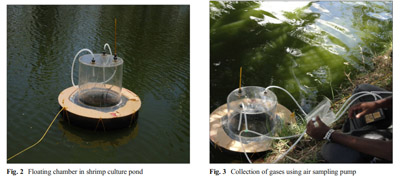
were collected using cylindrical acrylic chamber, air
pump, and tedlar bags. A cylindrical acrylic floating
chamber was fabricated to collect the GHGs emanating
from the surface of aquaculture ponds. The sampling
methodology was standardized and in-house method
validation was established by achieving linearity, accuracy, precision,
and specificity. GHGs flux was found to
be stable at 10 ± 2 °C of storage for 3 days. The
developed methodology was used to quantify GHGs in
the Pacific white shrimp Penaeus vannamei and black
tiger shrimp Penaeus monodon culture ponds for a
period of 4 months. The rate of emission of carbon
dioxide was found to be much greater when compared
to other two GHGs. Average GHGs emission in
gha−1 day−1 during the culture was comparatively high
in P.vannamei culture ponds. |
|
|
These
low-cost, floating chambers autonomously measure emissions from ponds
in the Arctic and the Amazon
https://www.woodwellclimate.org/zoe-dietrich-engineering-floating-methane-chamber/
|
“Chamber”
is a fancy word for the upside-down buckets we use to measure how fast
greenhouse gasses are released from different surfaces. By resting a
bucket upside-down on a patch of soil or grass or water and measuring
how fast gas concentrations increase or decrease inside the bucket, we
can calculate a “flux” of gas over a set area and time. Common methods
of measuring fluxes require manually collecting gas samples from a
chamber to be processed in a lab, or connecting the chamber to a high
precision analyzer that can cost around $40,000. These methods are
costly in salary time and equipment, limiting where, when, and how
often people can sample—usually daytime and in accessible areas and
times of the year. We need new low-cost and autonomous systems that can
measure around the clock to improve carbon emissions estimates. The
recent commercialization of cheaper sensors and control systems to
operate them, like the Arduino microcontroller, now make these
developments possible. |
|
|
|
|
|
|
|
|
|
|
|
|
|
|
|
|
|
|
|
|
|
|
|
|
|
|
|
|
|
|
|
|
|
|
|
|
|
|
|
|
|
|
|
|
|
|
|
|
|
|
|
|
|
|
|
|
|
|
|
|
|
|
|
|
|
|
|
|
|
|
|
|
|
|
|
|
|
|
|
|
|
|
|