Abstract:
This paper describes the design of a low-cost
radon detector that can easily be fabricated
in large quantities for the purposes of earthquake prediction. The
described detector can also be
used for monitoring radon levels in houses because high radon levels
pose a great health risk.
A very simple air-ionization chamber for alpha particles was used,
considering the experimental
results. Chamber current-sensing circuitry is also suggested, and an
Internet of Things (IoT) sensor
grid is described. The main advantages of this detector are the low
cost, low power consumption,
and complete elimination of high-voltage power sources. The minimum
detectable activity achieved
with the proposed detector for one measurement was around 50 Bq
· m−3
, with time of measurement
comparable to that featured on commercial devices, while the price of
the described detector is one
order of magnitude lower.
Radon-in-air
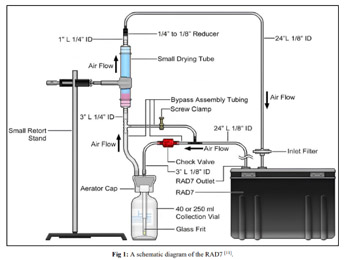
monitor (RAD7, Durridge Co.) has been widely used to measure222Rn
in water samples. RAD7 measures222Rn
via218Po+(t1/2=
3.1 min), which is electrically attracted to a silicon alpha detector.
In this study, a new method was developed for measuring222Rn
in water samples by modifying a commercially available pulsed
ionization chamber (PIC, FT-Lab Co.). The PIC detects and amplifies the
electric pulses generated by microspace charges produced by222Rn
decay. Two passive PICs (volume: 2 × 400 mL) were combined and
modified to form an active system (named Rn-SNU) that continuously
circulates air (~ 1 L min−1).
Rn-SNU is approximately seven to nine times more efficient than RAD7
and does not necessitate a delay of ~ 15 min to reach radioactive
equilibrium between222Rn
and218Po+.
However, RAD7 is more accurate in discriminating222Rn
daughters,218Po+and214Po+.
In this study,222Rn
was successfully measured in coastal seawater samples using Rn-SNU
connected to a grab bottle. Our results suggest that222Rn
measurements in water samples can be conducted more efficiently and
rapidly with an Rn-SNU than with other widely used instruments and
methods.
V. Mossa1,3,*, G. Roselli2
, C. Pastore1
, V. Paticchio1
, L. Vitucci2
1
INFN, sez. Bari, Via Orabona 4, 70125 Bari, Italy. 2
ARPA Puglia DAP Bari, U.O.S. Polo di Specializzazione Radiazioni
Ionizzanti, Via Oberban 18/E, 70126 Bari, Italy. 3
Università degli Studi di Foggia, Via Napoli 25, 71122 Foggia,
Italy.
Abstract
Long exposure to high radon levels leads to an
increase of developing lung
cancer risk, due to irradiation of lung tissue by the α particles
emitted by radon
and its decay products. Currently radon is considered to be the second
cause of
lung cancer, after only cigarettes smoke. Another very interesting
aspect related to the radon concentration is its potential use as a
seismic events precursor, according to some geophysical models that
suggest the release of radon
from the underground as a result of tectonic deformation responsible
for the
earthquake. The detector evaluated in this study is an ionizing
chamber, operating in free air at atmospheric pressure. It consists of
a metal cylinder used as
a cathode and a wire anode placed along the axis. It provides radon
concentration measurements with a fast time response, useful for sudden
changes in
radon gas emission. The prototype tested and discussed in this paper is
extremely compact, economical, with a long autonomy of operation, easy
to install and use. A new version of the detector has been developed
and characterized, with a cylindrical steel cathode, having a mesh
structure. The detection
performances are similar to the previous prototype with direct
operation into
the atmosphere and reduced weight, size and energy consumption. The
detector presented could be used in a widespread network on the
territory, in order
to evaluate the radon gas concentration in living environments and/or
to detect
radon emission before a seismic event.
This article
deals with the development of a ionization chamber-type in pulse
mode capable of performing measurements of the radon from the natural
background.
Its construction overcomes the problem of slow pulses deriving from
long collection
times of the ions using a special electrode structure along with
pulse-shaping
electronics that are optimized for high energy resolution and count
rate. The system is
composed of: one ionization chamber, a high voltage source, an
integrating
preamplifier, a data acquisition system and a computer. The paper also
presents a
novel method for radon concentration measurements that is based on the
alpha
counting with the ionization chamber and on a comparison of the
measurements of
radon concentrations with those obtained with a specialized system
Pylon AB 5.
Radon,
prevalent in underground spaces, requires continuous monitoring due to
health risks. Traditional detectors are often expensive, bulky, and
ill-suited forhumid
environmentsin underground
spaces. This study presents a compact, cost-effective radon detector
designed for long-term, online monitoring. It uses a smallionization
chamberwith naturalairflow,
avoiding the need for fans or pumps, and includes noise filtering and
humidity mitigation. Featuring multi-point networking and easy
integration capabilities, this detector significantly enhances radon
monitoring in challenging, underground conditions.
As more and more people are aware of the harm
of radon, the demand for radon measuring instruments will increase, and
radon measuring instruments have a broad potential market. According to
the theory that the α-ray from the decay of radon and its daughters can
ionize air molecules, a pulse ionization chamber radon measuring
instrument is designed, which has the characteristics of high
measurement sensitivity, good measurement accuracy and stability. The
system hardware consists of detection part, amplification and
discrimination part, data processing and control part and PC. Radon
measuring instruments can be widely used to monitor radon levels in
ambient air.
A B S T R A C T
Radon gas is a significant source of natural radiation
exposure in humans. In this
research, the responses of three different radiation detectors are
compared by preliminary
test results for Radon gas detection. First detector is a pulse-mode
counter developed by
using a BPW34 photodiode. To amplify and read out the output signal of
the photodiode,
a charge-sensitive preamplifier, based on a two-stage TLC272
operational amplifier is
designed. In the following, a pulse counting circuit is implemented by
using an ATmega32
microcontroller. The second developed detector is a current-mode air
ionization chamber
working at low applied voltages, with output signal enhanced by a
current amplifier
BC517 Darlington transistor, read out by an Arduino UNO module.
Additionally, an
alpha-sensitive Geiger-Mueller counter (model NT-960, Novin Teyf) with
a mica entrance
window is employed as the third detector. Soil samples containing
natural Uranium,
in companion with all three detectors were sealed in a chamber to study
the detector
responses to different concentrations of Radon gas. Findings indicate
that all three
detectors exhibit an increasing response as the concentration of Radon
gas is increased.
In the viewpoint of measurement accuracy, the Geiger-Mueller counter
provides more
accurate results due to a higher count rate and lower statistical
fluctuations, with a
concentration curve giving the half-life of Radon acceptably. The
ionization chamber is
shown to suffer from low sensitivity due to its current-mode operation.
Radon
(Rn-222) is one of Naturally Occurring
Radioactive Materials (NORM), which mean radioactive
materials found in environment. Among various NORM,
radon accounts for 52% of the exposure dose received
from natural radiation [1]. It is decay product of uranium238 that
exists in nature such as rock and soil. Radon
decays with half-life 3.82 days and emit 5.5MeV alpha
ray. The radon progeny also decays, emits radiation and
increases lung cancer risk. So residential radon exposure
should be controlled [2].
Recently indoor air quality issues including radon
have been brought up in Korea. So there is an increasing
need for household Radon Detector. Many continuous
radon detectors are on the market using scintillators,
semiconductors and gas detectors. Our purpose is
making a simple and inexpensive detector, we plan to
develop the ionization chamber as radon detector.
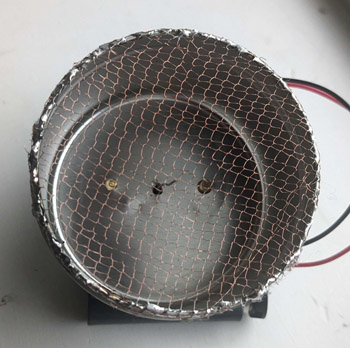
To
build the ion chamber, I soldered some wire to a steel can as one
electrode, drilled a hole in the closed end and inserted another wire
as the other electrode. I then covered the opening with metal mesh to
keep out static and stray fingers. Aluminum foil can be used for better
shielding from static electricity, but at the cost of blocking alpha
particles from entering
ABSTRACT
A method for determining small
quantities of radon is described, in which the
alpha particles from the radon and RaA and Rae are counted in an
ion-counting
chamber. Details of an arrangement for automatically making a printed
record
of the hourly totaled count are given. Advantages of this method over
that using an ionization chamber with electrometer are discussed.
It was
assumed in t he past t hat co un tin g of alpha particles in a ir-ioni
za tio n chambers could only be based on t he collection of ions sin ce
electrons produced in t he alpha trac k
qui ckly form negative ions in electronegative gases. This leads to t
ime resolutions of t he order of a milliseco nd. It is shown in t he p
resent work t hat t he motion of t he electrons before a ttac hment
produ ces a sha rp initial rise in t he p ulse profile which, alt hough
small, can be
detected an d u tili zed for high speed co un t ing. Time resolu tions
of t he order of a few mi cro- seco nds with good signa l-to-noise
ratios are realized in atmospheric a ir, a nd t herefore co untin g
speeds simila r to those in no n-electronegative gases are obtained.